Cold War Economics: How It Helped Stop Communist Expansion
 |
| http://www.hermes-press.com |
After the surrender of the Axis Powers in the summer of 1945, the Western Allies and the Soviet Union probably spent about five minutes celebrating together before the Cold War began. Each faction feared the expansion of the other sides political power into the parts of Europe and Asia that had been destabilized by years of war. Fears of a Third World War would only escalate as the Soviet Union grew jealous of the United States monopoly on nuclear bombs. However, both sides realized that a breakout of war could only lead to mutually assured destruction. Thus both sides began a long period of trying to undermine support for each other through the efforts of quasi-wars and economic sanctions.
If there was one reason Eastern Europe lagged behind the West in post-war development, it can be attributed to the Communists rejection of the Marshall Plan. The Marshall Plan was a plan for economic recovery meant not just for pro-U.S. allies in western europe, but for any nation willing to accept. The Soviet Union meanwhile feared that the influx of American goods and democratic ideas would upset their control of Eastern Europe and created the Council for Mutual Economic Assistance or COMECON as the communist alternative. While threats of military force cajoled the Eastern Bloc nations into COMECON, the Soviets recovery plan couldn’t match the Marshall Plan since at the time, 80% of world trade was handled by the Americans and 50% of the world’s production capacity was American. The differences between the two sides became all the more real when after the fall of Communism, many eastern Europeans were shocked at the extraordinary amounts of wealth and growth that existed in the West.
 |
| http://www.oocities.org/ |
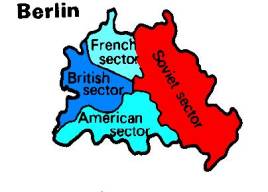
The American response was a bold plan to keep west Berliners supplied via the airports in the city which hadn’t been closed down. With U.S. supply plaines arriving every several seconds with aid, the Berlin Blockade served as a public relations disaster for the Soviets who were again reminded with the fact that while the Americans could feed and supply much of Western Europe, the Soviets could hardly have enough food to make it through the winter.
The final economic catalyst that proved to be the downfall of the Soviet Union did not come from any outside force but instead from the Perestroika and Glasnost reforms of Mikhail Gorbachev. After witnessing the decay of the Soviet system during the Brezhnev years, General Secretary Gorbachev created the Perestroika reform which attempted to promote the production of consumer and luxury goods and decentralize the corrupt state-owned businesses. Meanwhile his Glasnost social reform allowed for anti-communist thought to circulate throughout the populace. The culmination of a more capitalistic economy and a new found freedom of speech unleashed a wave of opposition from all over the Eastern Bloc in which Communist Party leaders were overthrown and democratic institutions spread up in place. After 74 years of dictatorial rule, liberal economics managed to help bring down the Iron Curtain.

No comments:
Post a Comment